
A Comparison of Neural Networks on the Double Pendulum System (GITHUB)
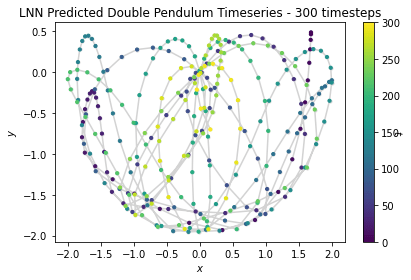
*This project was done for CS152 with Ziang, Guy, and Nathan
Link to website detailing full project report: PeNNdulum
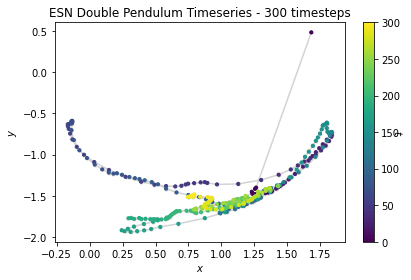
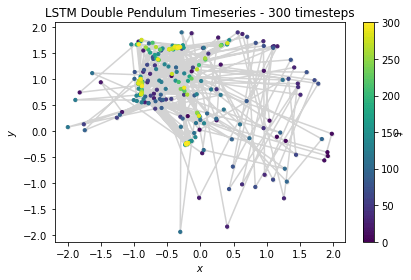
Lagrangian neural networks (LNN) output the Lagrangian for a system in motion. The Lagrangian characterizes the total energy in the system, and is a useful tool for solving for the mechanics of a system where a wider and more general range of dynamics are needed. The LNN was developed for extremely physics-specific tasks, and this makes it relatively narrow in scope. We seek to explore if the LNN is capable of outperforming a more general-purpose neural network that is highly successful at predicting the behavior of chaotic systems, Reservoir Computing (RC), the long-short term memory neural network (LSTM), which is excellent at forecasting sequential tasks, as well as a baseline fully-connected neural network model (FC).
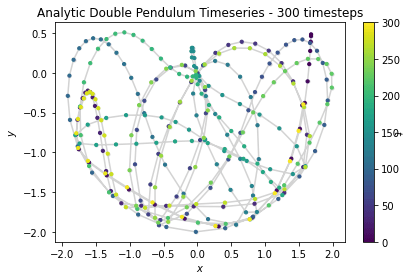
The task we will be using for comparison is the mechanics-based problem of forecasting the motion of a chaotic double pendulum. To verify this, we will train these networks on a dataset that is the analytical solution of a double pendulum over time. If RC and LSTM outperforms the physics-specific network, the LNN, then the utility of these networks substantially decreases. However, in this case, we expect LNN to surpass RC and LSTM, as the most common mathematical way to solve for the equations of motion for a double pendulum is by first solving the Lagrangian. Furthermore, we expect the LNN to yield better results than both RC and LSTM as its output has been proven to abide by the laws of physics and conserve energy, whereas RC and LSTM may not necessarily yield outputs that fall within physical constraints.
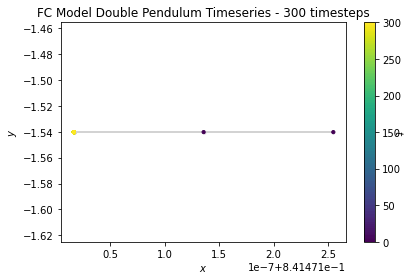
To get an understanding of the performance of each of these neural networks against a more common baseline model, we will also be comparing all three of these models against a generic feed-forward network that will serve as the control.
Finally, to test the validity of each model on new data, we will test each model on a set of simulated data, giving them each the same initial conditions. We can then both quantitatively and qualitatively evaluate how each model does to get a better understanding of their respective strengths and weaknesses.
Methods, conclusions, etc. can be found at the full website: PeNNdulum
 Tai Xiang's Random Projects
Leave a comment