Within the previous post, much of the mentioned content was aligned with business and industry. The maximization of profit, the tailoring away of human error in understanding consumer wants and needs: Sentiment analysis as a means to enhance profit margins and taper away personnel. However, this tool need not remain rooted within capitalism and the aggregation of opinions towards a product. Sentiment analysis is a powerful tool that is beginning to take shape in both academic research and a variety of interesting personal projects. History, literature, politics – the possibilities for sentiment analysis outside of the sphere of industry are quite numerous.
A group of researchers at Oxford utilized this technique on a corpus of Italian historical texts, seeking to uncover sentiments of a time period through the literature and preserved textual artifacts of the time. What was the atmosphere of an era? How did the people respond to certain significant historical events? These questions can be answered at a much quicker rate with a standardized scale of positivity and negativity that does not differ from a person to person basis. With the ability to comprehensibly map out opinion over time, researchers are able to uncover both the perspectives and thoughts on a topic and its change over time as people and society gradually evolve.
This idea of nailing down change over time was particularly exemplified in sentiment analysis performed by an individual at Forbes on New York Times articles published from 1945 – 2005.
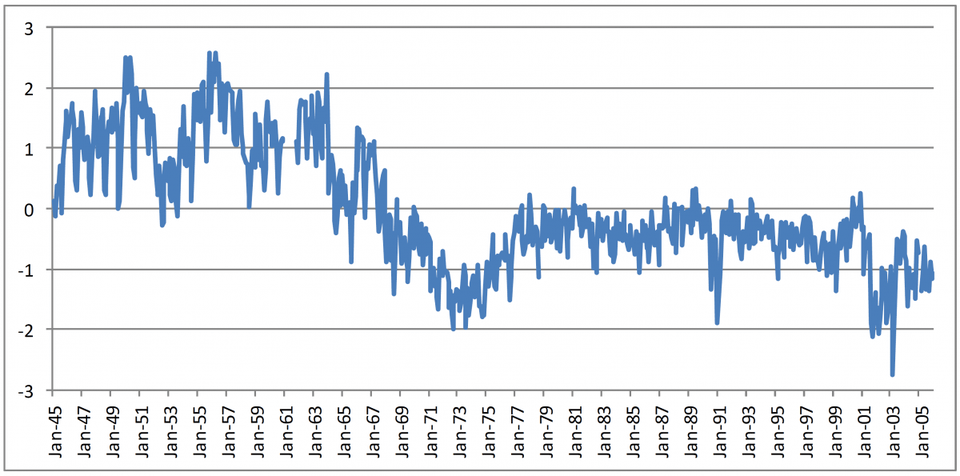
With the axis denoting perception (positive, neutral, negative, with 3 being most positive and -3 most negative), we are able to see this gradual shift of human sentiment in America over time. Leetaru attempts to align these sentiments with certain significant historical events (similar to my goal) and speculates that these changes in tone align with events such as the Korean War, the Afghanistan and Iran Wars, 9/11, and other events that shifted the policy and atmosphere of the United States.
Shifting from a historical lens to a literary lens, an interesting project that has recently taken shape is SentiArt, a sentiment analysis tool developed by Arthur Jacobs that is able to analyze characters of a fictional text. A sample usage for SentiArt is the analysis of character emotional potential and general personality profile. Jacobs’ tool varies from the realm of business and industry related sentiment analysis primarily because of the way it determines sentiments. Instead of solely relying on the labeling and assignment of numerical value to human speech, Jacobs utilizes the scale and attribution of the ‘big five’ (openness, conscientiousness, extroversion, agreeableness, neuroticism) personality psychological theory as a means to determine emotional potential.
This similar linkage of emotion is also being applied at the University of Salamanca in Spain, where researchers are attempting to link various musical flourishes and fragments with the evocation of human emotion. By labeling staggering amounts of segmented musical fragments with a certain human emotion that is experienced by an aggregated set of listeners. This model could relate various timbres or rhythms to an emotion, thus possibly answering the question of what makes a song sad or happy outside of the relatively broad strokes of minor and major keys, chord shapes, and other rather technical elements.
Sentiment analysis, despite its heavy usage in industry and business, need not solely be perceived from that frontier. With the accessibility and pre-existing labeled data sets, the use of sentiment analysis by an average individual is quite possible for lighthearted inquiry. For researchers and scientists well-versed in its usage, it represents an immensely powerful tool that is developing at an exponential rate. Saving manpower, saving time, providing consistency, sentiment analysis can be used to examine a variety of human notions that seem far removed from the cold rigidity of technology and computing. Its applications to various fields are endless, and as sentiment analysis continues its explosion in popularity its place in academic and research seems likely to become further cemented.
 Tai Xiang's Random Projects
Leave a comment